A readable transcript is not necessarily a checked transcript. Before an interview becomes an article, research note, customer story, or internal brief, someone should compare its important wording with the recording. This checklist gives that review a repeatable order. It puts attribution, exact wording, context, and unresolved audio ahead of cosmetic cleanup, so the final text says no more than the source supports.
Set the review standard before you listen
The destination of the interview determines how closely each passage needs to be checked. A published quote may need word-for-word review. A research transcript may need accurate terms, dates, and speaker attribution. An internal brief may need a clear distinction between what the guest said, what the interviewer suggested, and what remains an open question.
Write a short source list before playback: participant names, roles, organisation names, products, specialist terms, and dates you expect to hear. Then mark the passages with the greatest cost of error. This is faster to manage than treating every filler word as equally important, and it gives another reviewer a clear brief if you need help.
- Name the document that will be produced from the transcript.
- List spellings and terms that the recording alone may not make obvious.
- Mark direct quotes, factual claims, and sensitive passages for close review.
Confirm that the transcript is complete and in order
Start with a structural pass before correcting words. Check that the beginning and end of the interview are present, that answers follow the right questions, and that no obvious stretch of the conversation is missing. A polished sentence cannot repair a missing section or a sequence that has been put in the wrong order.
Use the timed transcript as a map while the recording remains available. VoiceCut shows transcript segments with timestamps and speaker labels, which helps you describe where a problem occurs. The timestamp points to a place to inspect; the recording is what confirms the wording. Note any abrupt change in time, topic, or speaker for a closer listen.
- Check the opening, closing, and any pause or interruption in the interview.
- Scan timestamps for unexpected gaps or out-of-order passages.
- Make sure each answer sits beside the question or prompt that gives it meaning.
Verify speaker attribution without guessing
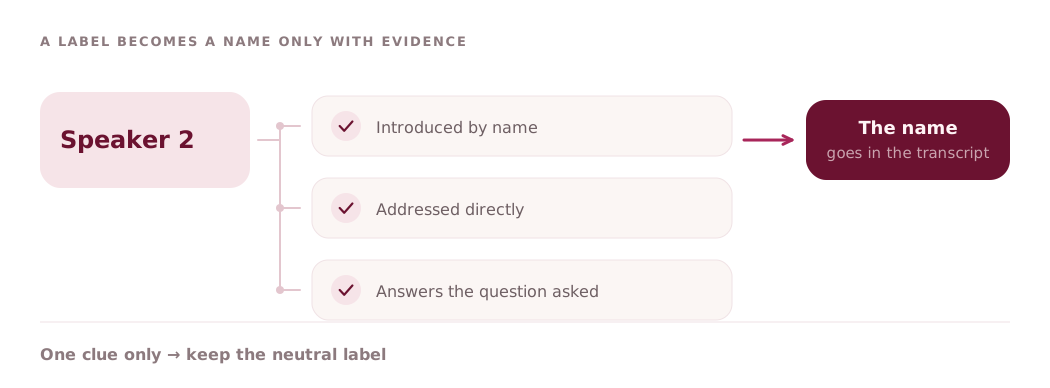
Speaker labels help separate voices, but a label does not prove a person's identity. In a two-person interview, the pattern may look obvious until someone interrupts, reads a quotation, or another voice enters the room. Check the opening introductions, direct forms of address, vocal cues, and surrounding questions before attaching a statement to a named person.
Keep neutral labels when the identity is not established. Record the timestamp and ask the interviewer, producer, or participant to resolve an important attribution. A transparent note is better than assigning a strong opinion or sensitive detail to the wrong person. Review label consistency across the whole interview after making any correction to the text.
- Match each known participant to more than one contextual clue.
- Recheck overlaps, interruptions, and short acknowledgements.
- Leave an unresolved speaker neutral until a person can confirm the identity.
Check the details that can change the meaning
Re-listen to names, numbers, dates, currencies, product terms, locations, and quoted titles. Pay close attention to small words such as not, may, could, before, and after. One missed qualifier can turn a possibility into a promise or reverse the meaning of an answer even when the rest of the sentence looks fluent.
For every passage you plan to quote, listen to the sentence before it and the sentence after it. Check whether the speaker is answering directly, repeating another person's view, making a joke, or adding a condition. Keep a meaningful hesitation or self-correction when removing it would make the claim sound more certain than it was.
- Verify names and spellings against the source list.
- Read numbers aloud while replaying the matching passage.
- Check that a shortened quote still carries the speaker's original condition or limitation.
Edit one passage at a time
VoiceCut keeps recording playback with editable transcript text, timestamps, and speaker labels. Pause at the target passage, replay a short range, and correct only what the recording supports. Work in small units so that an edit to one line does not quietly change the meaning of the next speaker's reply.
Aim for faithful, readable speech rather than a rewritten essay. Correct a misheard word and add punctuation where it clarifies the sentence, but do not replace the guest's vocabulary with your preferred phrasing. If noise or overlap prevents a confident reading, keep an explicit note in your review material and return to it with a second listener.
- Preserve negation, uncertainty, and meaningful self-corrections.
- Do not smooth a proposal into a decision or a recollection into a fact.
- After each edit, read the surrounding question and answer together.
Run the final pre-share check
Read the high-risk passages once more with the recording open. Confirm the speaker label, exact wording, spelling, timestamp, and nearby context. Then compare any article draft, summary, quotation list, or handoff note with the corrected transcript, not with an earlier copy saved before the review.
Before sending the transcript, state what was checked and what remains unresolved. Open the exported file if you created one and inspect the critical passages there as well. A short handoff note, such as one uncertain name at a given timestamp, lets the next person continue the review without assuming that silence means certainty.
- Confirm every quote that will be published or attributed.
- List unresolved audio and the timestamps needed for follow-up.
- Send the recording, transcript, and review note according to your team's access rules.
Check your next interview in VoiceCut
New accounts receive 30 trial minutes. No payment card is required.