
A transcript is useful only when the important wording survives contact with the recording. Speech recognition can miss a name, join two speakers, or turn a careful qualification into a confident statement. The answer is not to replay the whole file from the beginning. Review the text in passes, use timestamps as coordinates, and keep a short record of anything that still needs another pair of ears.
Decide what the transcript must prove
Start with the job the transcript has to do. A journalist needs exact quotes and attribution. A meeting owner needs wording that distinguishes a decision from a suggestion. A subtitle editor needs the spoken text to match the picture while the cue timing remains usable. These are different review jobs, even when they begin with the same recording.
Mark the passages with consequences before you listen: names, figures, direct quotes, decisions, dates, technical terms, and sentences that may be published. Routine connective speech can wait. This keeps the first review focused on meaning instead of punctuation preferences.
- List the names and specialist terms you expect to hear.
- Write down the quotes, decisions, or cues that need the strongest check.
- Choose the export you need so you know which details must survive the review.
Prepare the recording and a source sheet
Keep the original recording available while you review. Do not treat an exported document as the source. The audio or video is the source; the transcript is a working representation of it. If the recording has several speakers, make a small source sheet with the names you know, their roles, and any spellings that are easy to confuse.
VoiceCut shows transcript text with speaker labels and timestamps. A label may identify a voice without proving a person's name. Use your source sheet and the surrounding conversation to check attribution. If you cannot establish who spoke, leave a neutral label or add a note instead of guessing.
Review in separate passes
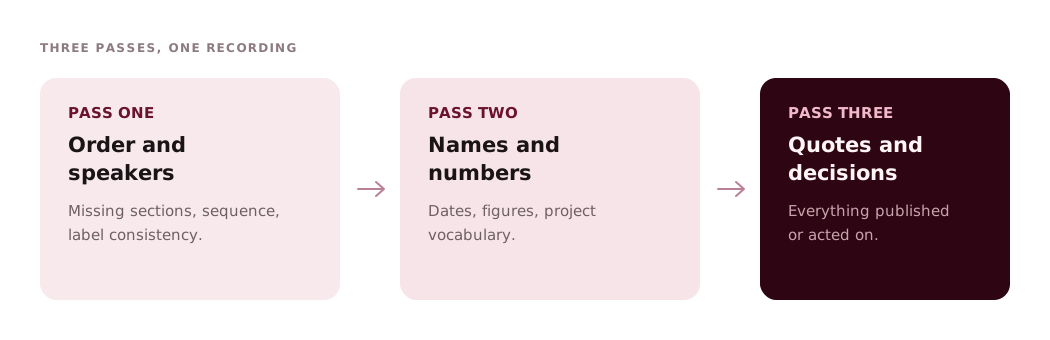
Trying to correct every kind of problem in one pass makes it easy to miss the sentence that matters. First read for structure: does the order follow the recording, and are speaker changes plausible? Next check names, numbers, and terminology. Finish with the passages you plan to quote or act on.
Listen to a little context before and after each target line. A single sentence may sound decisive when the next sentence adds a condition. A pronoun may point to a person named ten seconds earlier. Keep enough context to preserve the speaker's meaning, but do not rewrite spoken language into something more polished than the recording supports.
- Pass one: order, missing sections, and speaker-label consistency.
- Pass two: names, numbers, dates, and project vocabulary.
- Pass three: quotes, decisions, actions, or subtitle wording.
Use timestamps as coordinates
A timestamp is a coordinate, not proof by itself. Use it to locate the matching part of the recording, then listen. When the wording is disputed, note the timestamp with the correction so another reviewer can find the same passage without searching through the whole file.
Work in short ranges. If a sentence begins at one timestamp and the relevant qualification follows in the next segment, check both. For a long answer, record the start and end of the useful passage. This is especially important when a quote will be shortened, because the omitted context may change its meaning.
Correct the text without hiding uncertainty
Edit a transcript line when the recording supports the correction. Preserve the speaker's words, including a meaningful hesitation or qualification, rather than replacing them with the sentence you expected to hear. Normalise punctuation only when it improves readability without changing the claim.
Some passages remain unclear because of overlap, noise, or an unfamiliar name. Mark that uncertainty in your working notes and ask a second reviewer or the speaker when the stakes justify it. A blank, neutral label, or explicit note is safer than a confident invention.
- Change a name only after the recording or a reliable source sheet supports it.
- Keep a question as a question when the speaker's delivery is ambiguous.
- Do not turn a proposed action into an agreed action during cleanup.
Run a final check before export
Read only the high-consequence passages once more while the recording is open. Confirm the spelling, speaker label, timestamp, and surrounding context. If the transcript feeds a summary, protocol, article, or caption file, compare that downstream text with the corrected transcript rather than with an earlier draft.
Export after the review, not before it. DOCX and TXT are useful for reading and editorial work; JSON preserves structured data for another tool; SRT and VTT carry subtitle cues based on transcript segment timings. Keep the original recording and your review notes according to your own retention rules so the published wording can still be checked later.
- Confirm every published quote and attributed statement.
- Check that decisions and actions still read as drafts until a person confirms them.
- Open the exported file and inspect a few critical passages before sending it on.
Review an interview recording in VoiceCut
New accounts receive 30 trial minutes. No payment card is required.